

The emerging pathway to a fully functioning country
If separatism threats once got Ottawa's attention, their time has passed

It appears Albertans – the overwhelming majority at least – are in a very reasonable state of mind and are ready to work with the other provinces to make this country work. Can we just get past the puerile threats already?
At least two-thirds of Albertans do not want to separate from Canada, if you are to believe poll after poll after poll. This even though they still have significant grievances with the way Ottawa treats the province. It’s obvious that if we want to put the separatism chatter to bed once for all, now is the moment to address the biggest longstanding irritants.
Those grievances are why those polls consistently show that many Albertans say they are toying with the idea of separation if the relationship with our federal government doesn’t improve. The separation-curious crowd, in effect, believes that posing an existential threat will force the federal government to take Alberta’s grievances seriously.
Any experienced negotiator will tell you threats will only get you so far. Incessant warnings of “do this or else” eventually lose their ability to trigger a desired response and can in fact cause the other side to dig in even deeper. For proof, look no further than U.S. President Donald Trump’s threat to Iran: “A whole civilization will die tonight, never to be brought back again.” Thankfully, he wasn’t serious but – bad luck for him – his opponent knew it.
Angry Albertans aren’t talking about anything as crazy as what the U.S. president says he would do, but the radicals among them are talking about ending Confederation. And, whether you credit those threats with getting Ottawa’s attention or attribute the new attitude to some other cause, something has woken up the elites in the East.
So, it’s time to start talking about what a fairer deal would look like.
Alberta-born Prime Minister Mark Carney has gained favour with moderate Albertans by backing away from the anti-O&G policies of the Justin Trudeau era. The memorandum of understanding Carney signed with Alberta Premier Danielle Smith in November 2025 to advance a new bitumen pipeline to the British Columbia coast holds promise of a whole new attitude from Ottawa.
But a recent poll suggests winning the hearts of Albertans is about a lot more than oil and gas. It means moving away from old paradigms and avoiding hot-button terms that almost always trigger irrational fury.
The poll, conducted by Vox Pop Labs (the folks who bring you Vote Compass), made a few eyebrow-raising discoveries. Among them, the data suggest strong support amongst Albertans for federal programs, such as equalization, that help ensure all provinces provide comparable public services.
That’s right: equalization, the issue the pro-separation crowd so consistently latches on to. Which is not to say Albertans are OK with equalization as it exists. Even the word itself has taken on larger-than-life demonic properties. When the Vox Pop pollsters asked about attitudes towards “equalization,” half of Albertans strongly or somewhat oppose the federal program.
But the interesting thing is that when the e-word was eliminated, attitudes changed. When Albertans were asked about transferring “money to the poorer provinces in order to ensure that Canadians living in every province have access to similar levels of public services,” opposition dropped to 42 per cent, and a majority of 57 per cent supported it.
Further, the majority of those who oppose equalization said it simply needs major reforms rather than abolishing it entirely. Among the faults, opponents said, is that the federal government does not make decisions about the program transparently. They also don’t believe decisions are easy to understand.
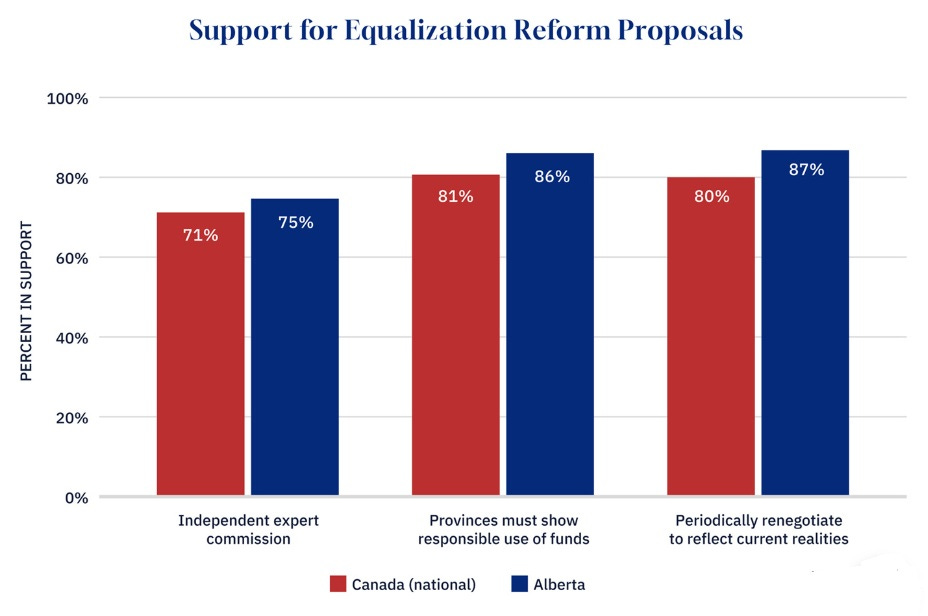
“Here’s where there may be an opportunity to improve not only the broader functioning of fiscal arrangements in Canada but also public support for specific transfer programs,” economist Trevor Tombe and journalist Brookes Decillia wrote in an analysis of the poll.
Suggested remedies include periodic renewal and reforming of the equalization formula to reflect current economic realities. (The formula is more than 20 years old.) And Canadians believe provinces receiving equalization should demonstrate to the federal government that funds are being used responsibly.
For federalists, this is good news because it creates a pathway to a country that functions better than it has been. As with the removal of interprovincial trade barriers, significant reform of equalization could be considered low-hanging fruit that will settle the biggest grievances that fuel the fires of wild-eyed separatists. And with the threat of U.S. annexation as a backdrop, our political leaders may finally find the courage to ensure real reform is more than idle chatter; that real change can and will happen.
I have believed for a long time that at least some of the people who want Alberta to go it alone do so because they just don’t believe the country will ever work. It’s hard to disagree with them that there has been a long history of Ottawa ignoring or ragging the puck on reforms that westerners have been demanding.
Maybe it’s real this time. Maybe Canada’s forced breakup with the U.S., and the realization that our country has to assert its independence, will unstop the dams that have held back meaningful progress. As an incurable optimist, I believe we are witnessing the beginning of such change.
As this unfolds, it is time to recognize that the tiresome and disruptive separatism discussions need to end. If they were at one time useful to lighting a fire under intransigent Ottawa, they are now threatening to subvert our renewed desire to get this nation out of second gear.
Politicians also need to stop trying to mollify the malcontents. The UK’s David Cameron learned that lesson the hard way when he called a referendum, thinking that Britons would reject the idea of leaving the European Union. The ensuing Brexit disaster is a sobering reminder that when politicians resort to cop-outs like referenda, it can lead to unintended consequences. Albertans need to stop toying with separatism, or they might just end up with a reality they never bargained for.
Instead, let’s collectively do the things we need to make this country work.
* * *
CHIPSHOT: As scandals go, it’s hard to beat revelations that David Parker and his pro-separatist group Centurion Project illegally got their hands on a list of electors and published it on its website. It is an outrageous violation of privacy laws and it shows how low the separatists and their U.S.-backed supporters are prepared to go. The perpetrators had better be held to account. And it’s fair to ask: Will this be the offence that stops Premier Danielle Smith from playing footsie with such an unseemly gang?
EDITOR’S NOTE: If you want to discover how amazing this country already is, check out my book, Crosswinds: A cross-country bike ride that revealed why Canada is worth fighting for. Available in paperback and Kindle formats on Amazon.ca.
©DougFirbyUnfiltered
Reprint with credit to dougfirby.substack.com
The UCP enabled the eroding of the protection of our data by Bill 54 and Bill 14 despite having been warned of the risks. This does not fall solely at the feet of the separatists. They were aided by the UCP and the Premier. The MLA’s supposed to represent us are not doing their job. Signing off on every bill despite the inherent risks of those bills is not happenstance. The Premier is not doing her job to support ALL Albertan’s. They have effectively all broken their oath of office. An election needs to be called.
I like your notion of a pathway coupled with a change in the language
Reasonable people will come to reasoned results once the rhetoric is displaced