

Alberta's reckless, feckless AI-data centre fantasy
These energy-gobbling facilities may have already seen their heyday

We’re all familiar with it: that quiet little voice that whispers an offer is too good to be true. Our Spidey sense tells us that there has to be a catch, even if we don’t yet know what it is.
I had that feeling when I learned of plans to build several power-gobbling data centres in Alberta. Proponents promise prosperity, jobs and an unprecedented economic boost to regions hungry for investment. It’s the sort of boosterism that brought huge smiles to Alberta Premier Danielle Smith, whose government envisions turning the province into an artificial intelligence and data hub.
But there is good reason to question not only whether these promises will be fulfilled but also at what cost.
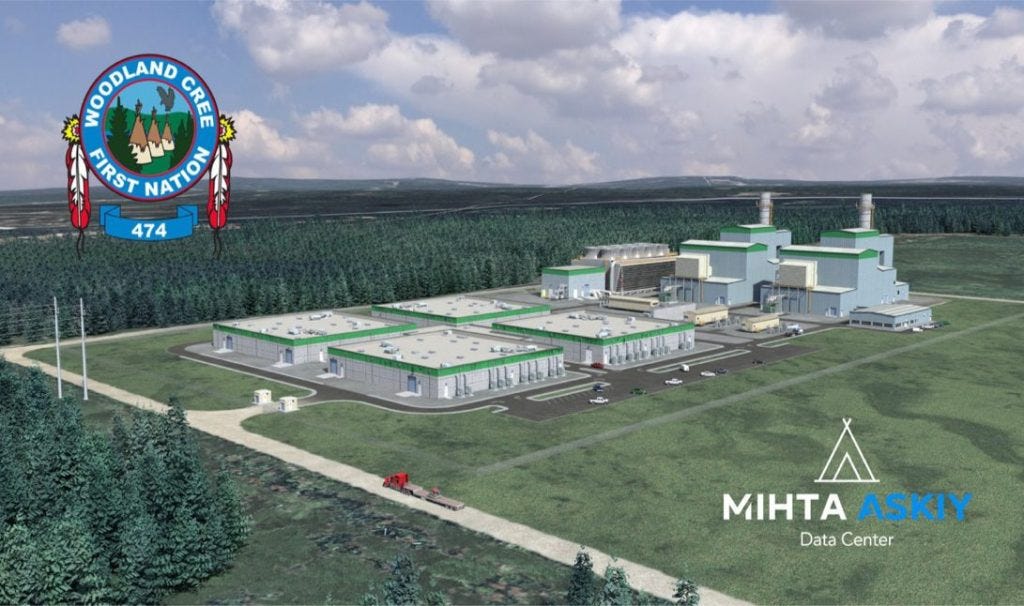
Among the mega-projects in the works:
The Mihta Askiy Data Center [sic] Project is to be located about 40 kilometres northeast of Peace River. Proponents say the $15-billion facility will feature a 650-megawatt natural gas-fired power plant, create hundreds of jobs during construction and as many as 100 permanent jobs, and bring new prosperity to an economically struggling part of Alberta.
The Wonder Valley Project, in the Municipal District of Greenview, south of Grande Prairie. It’s being promoted by none other than Mr. Wonderful, huckster-in-chief Kevin O’Leary through his company O’Leary Ventures. The proposed 7.5-gigawatt AI data centre campus is to span thousands of acres, powered by its own natural gas and geothermal infrastructure.
Meta Inc., meanwhile, is building a $13-billion AI data centre north of Edmonton. It will consume about one gigawatt of electricity – roughly 70 per cent of what the city of Edmonton draws – from an adjacent purpose-built natural gas plant.
And of course, there is the proposed Synapse project in Olds, just an hour north of Calgary. In this case, more than 1,100 intervenors have raised concerns about the proposed $10-billion artificial intelligence data centre and attached gas power plant, causing the project to be put on pause.
There is a broad spectrum of environmental concerns behind objections to these data centres. Opponents don’t like the idea of new heavy industrial activity, industrial noise and heavy water usage. They also wonder whether the facilities will drive up the price of electricity and natural gas, which is required in massive amounts to generate the needed electricity.
It also strikes me as more than ironic that the province has severely limited deployment of solar panels, alleging (mostly incorrectly) that they take farmland out of production, and yet it is more than willing to give up thousands of acres of land for these industrial facilities.
As AI use grows exponentially in North America, so does power demand to drive it. One estimate is that data centres already consume two per cent of global electricity. The website Shortform notes that a ChatGPT query uses almost 10 times the electricity of a Google search. It states: “A single data centre can consume up to 18 megawatts—enough to power 14,400 homes—with larger campuses using up to one gigawatt, comparable to powering most of San Francisco.”
In Northern Virginia, more than one in five residents live within 1.6 kilometres of a data centre, and report constant noise from cooling systems, which residents compare to never-ending leaf blowers. In Georgia, meanwhile, more than 50 data centres have increased average household electricity bills by nearly $200 annually.
And yet in Alberta, the fools in our provincial government are rushing in to embrace a technology that – it turns out – is quickly turning passé, and perhaps even obsolete.
Law professor Robert Diab argued in a column in the Globe and Mail last week that, “AI data centres may turn out to be overbuilt, or even obsolete, by the time they are finished.” That’s because AI processing is shifting from cloud-based centres to personal devices, such as our laptops and cell phones.
Of the many emerging device-resident AI systems, I was deeply impressed by an app called chatjimmy.ai that a friend recently showed me. Explaining how it works would take us off track, but in simple terms, ChatJimmy works by hardwiring an entire artificial intelligence model directly into a custom silicon chip (ASIC). Results to a query appear typically in 0.012 seconds. No data centre involved.
Diab also notes that Apple’s next operating system for the iPhone and Mac, coming this fall, will include an updated AI assistant that will handle many everyday requests on the device itself, without sending them to the cloud.
On Friday, I received a form letter from Grant Hunter, minister of Environment and Protected Areas, which stated in part: “In Alberta, an Environmental Impact Assessment (EIA) is required where potential environmental effects are uncertain, where unproven technologies are involved, or where cumulative effects may significantly impact the environment. While a proposed data centre project may be large in scale, it uses established technologies for power generation and water infrastructure that are already well understood and regulated in Alberta. The sustainability of watersheds is a key consideration in water licence decisions.”
If I’m reading that correctly, the minister is arguing that since data centres use proven technologies an EIA is not required. I’m pretty sure that response is not going to satisfy a lot of opponents to data centres.
It’s too soon to declare that data centres in Alberta will become a collection of white elephants, but there is good reason to believe they are rapidly being overbuilt. For Alberta, that may mean that some of these projects will not live up their promise as massive economic drivers and job generators.
Instead, they will become ugly symbols of a government driven by too much thoughtless enthusiasm and not enough caution.
There is widely accepted wisdom that if your friend at the coffee shop gives you a hot tip on a stock, it’s already too late to buy it. In the same way, it seems Alberta’s government is late to the AI data centre party. And, given the environmental concerns and public opposition to these noisy, energy and water gobbling centres, that’s not necessarily a bad thing.
Economy Media reports that half of the data centres in the U.S. are being delayed or cancelled. As one commentator quipped, “The bubble is popping, not with a bang, but with a quiet and pungent fart.”
The Alberta government is in danger of being caught downwind. It needs to smarten up and slow down its rush to embrace a technology that may have already seen its heyday.
* * *
CHIPSHOT: There is ongoing debate on whether Prime Minister Mark Carney gave up too much to clear the way for the opening of the $6.4-billion Gordie Howe Bridge, a Canada-funded transportation link that connects southern Ontario to Michigan. The simple fact is U.S. President Donald Trump saw a chance to shake us down and he took it. He tore up an agreement that was reached in good faith and held Canada to ransom. Carney salvaged what he could. Blackmail, it appears, is the real art of the deal. Long term, of course, this ugly incident is yet another reminder that agreements with this U.S. Administration are not worth the paper they are written on.
REMINDER: You can avoid the chaos and hours-long wait to vote in Alberta’s fall referendum. Send in your request now to receive a mail-in ballot.
©DougFirbyUnfiltered
Reprint with credit to dougfirby.substack.com
EDITOR’S NOTE: For the ultimate analogue experience, check out Crosswinds: A cross-country bike ride that revealed why Canada is worth fighting for. Available in paperback and Kindle formats on Amazon.ca.
Excellent piece. I too received that pre- formed form letter from the “environment “ minister. I wrote back a - what I think - is a scathing letter, pointing out similar concerns. I urge everyone to do the same.
One addition to the referendumb 😂 voting discussion. There will also be in person early voting from Oct 13-17. Polls will be open 9 am - 8 pm each of those days.
One other piece for your puzzle.
Outside of municipalities such as cities and town’s foreign ownership of land is restricted to a maximum of 20 acres on two titles.
How do Dani’s new buddies get this exemption?
Perhaps we should start a list of things she has done to circumvent our laws and regulations.
Lastly- Ask not what Smith and the ucp have done for Alberta. Rather ask and answer what have Smith and the ucp done to Alberta!